Loan Officer Intelligence
Conceived, built, and launched a lead-intelligence platform that takes mortgage professionals from raw signals to qualified, prioritized opportunities — from concept to paying customers with zero external funding.
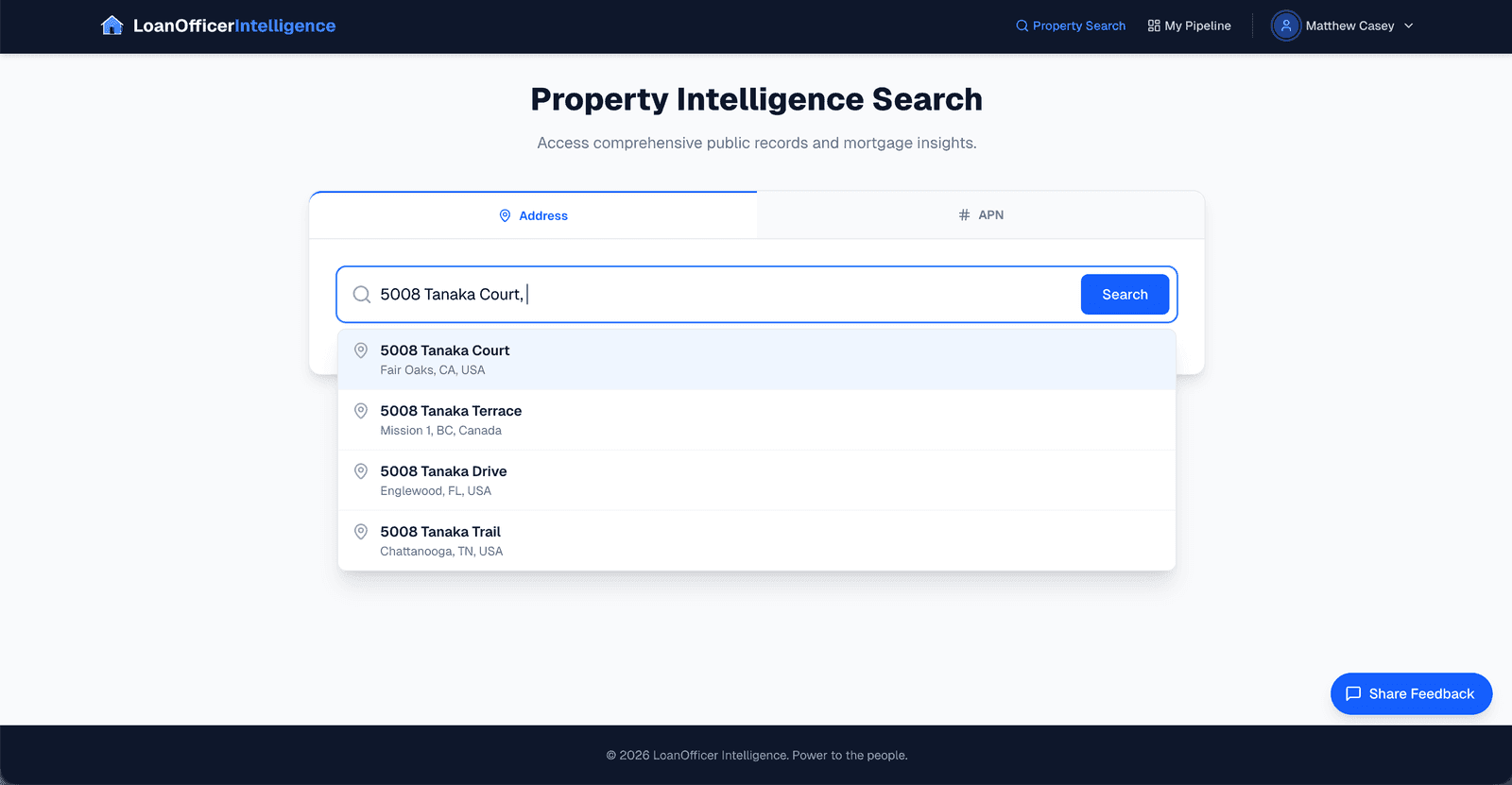
Property Intelligence Search — address & APN lookup with smart autocomplete.
$0
Funding raised
Solo
Concept to paying customers
AI-accelerated
Build approach
63%
Gross margin at current scale
Overview
Loan Officer Intelligence helps mortgage professionals spot, score, and act on the right opportunities at the right moment. I owned the product end to end — discovery, pricing, build, and go-to-market — using AI-accelerated development to compress the path from idea to revenue, then used real usage data to correct my own initial assumptions before scaling spend.
The problem
From the moment a Loan Officer starts a conversation with a prospective lead, they are needing to rapidly surface details to both qualify the lead and to tailor their approach to help build trust. Loan Officer Intelligence provides LOs with the insights they need in seconds. Allowing them to spend their time on the right opportunities and stay one step ahead in the conversations.
My approach
Ran rapid customer discovery with working loan officers to separate real workflow pain from nice-to-haves.
Used AI-accelerated tooling (Claude Code, the Vercel AI SDK) to design, build, and iterate the full product independently.
Validated pricing and positioning through hands-on prototypes before committing engineering effort.
Shipped in tight loops, letting early paying customers shape the roadmap week over week.
Validating the business model
Before committing to a pricing structure, I ran a deliberately underpriced beta — unlimited searches for $30/month — with a high-volume refinance office. The goal wasn't revenue, it was data: I needed real usage numbers before locking in a package. The result corrected a real assumption. I had sized the initial tier around 150 searches/month; actual usage came in well below that. That test let me build a smaller, more affordable package that matched real behavior, protected margin, and left explicit room for upsell as usage grew — rather than guessing at a number and hoping it held.
In parallel, I instrumented individual API calls to understand how loan officers actually used property data mid-conversation — which fields they pulled, when, and why — and used that telemetry to rebuild my own cost structure around real usage patterns instead of theoretical worst-case load.
I also mapped distinct LO personas and assigned a hypothesized value to each, then ran direct outreach and discovery to test those assumptions. The value hypothesis largely held — but the exercise surfaced a sharper insight: many of the LOs I assumed were underserved already had access to enterprise-grade tools through their brokerage. That reshaped who I built for and how I positioned the product.
Business fundamentals
63% gross margin
at current scale, calculated against data licensing, hosting, and maintenance costs.
Under 10% monthly churn
held without discounting — retention issues have been resolved through product and support, not price.
5% free-trial conversion
currently the top-priority metric I'm diagnosing before investing further in acquisition.
Profitability achieved
from early customer commitments, ahead of any formal go-to-market spend.
Market timing & growth strategy
Mortgage origination volume is highly cyclical, expanding and contracting with interest rates. Rather than force growth in a compressed part of that cycle, I'm using this period to build trust and product depth with a core user base — so the product is ready to scale distribution the moment origination volume turns up. The near-term growth plan is a referral program aimed at the existing user base, paired with outreach automation informed by the feedback loop that program generates.
Positioning research also shaped who I'm building for. Tools like CoreLogic, DataTree, FlueidPro, and Fidelity Passport are priced and packaged for large brokerages. A growing segment of smaller, high-volume offices — and the individual LOs inside them — are underserved by anything self-serve. The product is positioned not just to fill that gap, but to offer those individuals the independence of a tool they control themselves, without an enterprise contract standing between them and it.
Tech stack
Methodologies
Curious about the details behind this work?
I'm always happy to walk through the decisions, tradeoffs, and outcomes in depth.
Get in touch